Long before he revolutionized photography, Edwin Land was already a highly successful inventor known for his groundbreaking work in manipulating light. After dropping out of college to pursue his own research,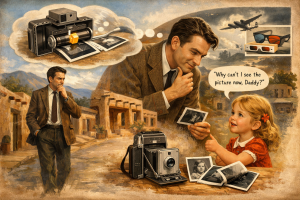 he invented the first inexpensive polarizing film, which led to the creation of the Polaroid Corporation. His polarizing technology was used to create glare-reducing sunglasses, 3D movie glasses, and advanced military optics during World War II. However, in the early 1940s, photography remained a cumbersome and delayed process; taking a picture meant exposing a roll of film, sending it away to a laboratory for chemical processing, and waiting days or weeks to finally see the image.
The trajectory of photographic history changed forever in 1943, entirely due to the innocent impatience of a child. While vacationing in Santa Fe, New Mexico, Land snapped a photograph of his three-year-old daughter, Jennifer. Accustomed to the immediacy of human sight, she asked him a deceptively simple question: why couldn’t she see the picture right then and there? Most adults would have simply dismissed the question by explaining the rigid technical rules of darkroom chemistry. Land, however, possessed a fiercely unconventional mind and viewed his daughter’s question not as a misunderstanding, but as a brilliant, fundamental challenge to the status quo.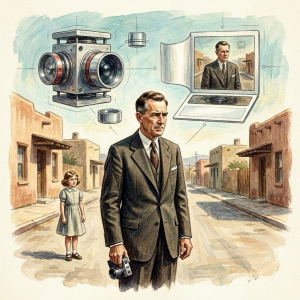
Inspired by his daughter’s vision of what photography actually should be, Land immediately set out on a solitary walk around town, his mind racing through the physics and chemistry required to make her wish a reality. Within just a few hours of intense focus, he mentally constructed the entire system. He envisioned a camera that contained both the film and the darkroom within a single handheld device, using a pair of internal rollers to crush a tiny pod of processing chemicals and spread them evenly across the exposed paper. By the time he returned to his family from that walk, the core mechanical and chemical concepts of the instant camera had been fully mapped out in his head.
It took five years of relentless engineering to bring that single afternoon’s vision to life, culminating in the commercial release of the Polaroid Land Camera Model 95 in 1948. The invention was an absolute sensation, allowing ordinary people to peel apart a fully developed photograph just sixty seconds after pressing the shutter. Sparked entirely by a toddler’s simple, impatient question, Land’s invention fundamentally transformed society’s relationship with images, birthing a culture of spontaneous, immediate visual sharing that laid the psychological groundwork for the modern smartphone era.