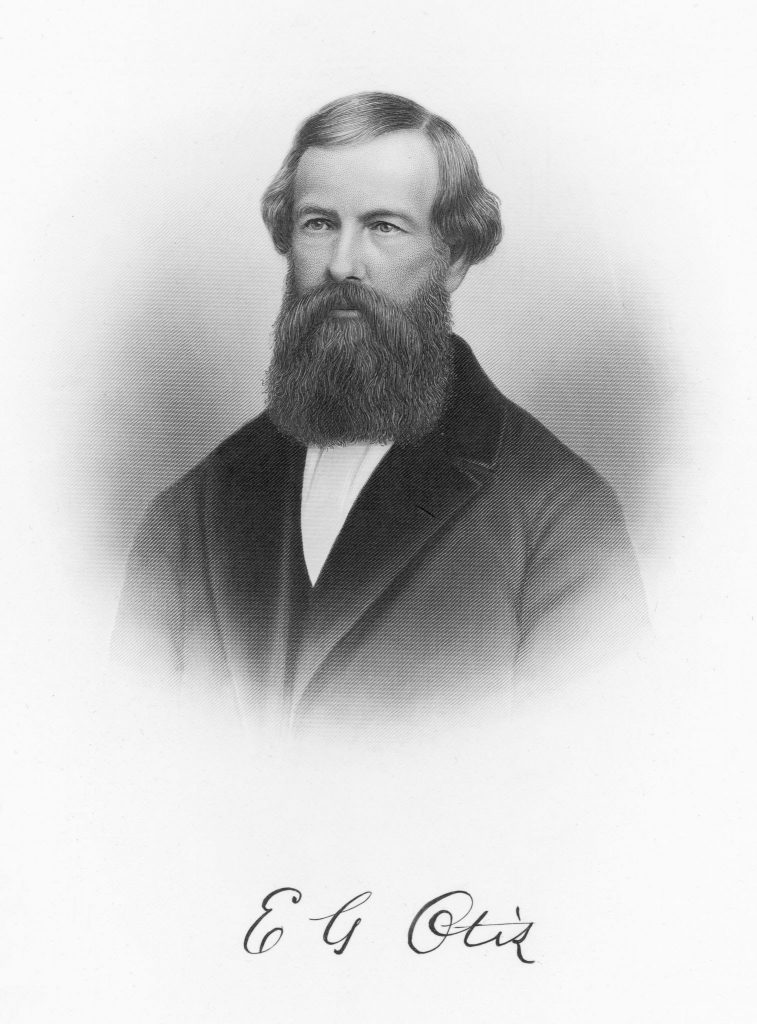
Elisha Graves Otis (August 3, 1811 – April 8, 1861) was an American industrialist, mechanical engineer, and inventor who revolutionized vertical transportation with the invention of the safety elevator. By designing a fail-safe mechanism that prevented an elevator car from plummeting if its hoisting cable broke, Otis eliminated the primary safety hazard of early hoists, laying the crucial engineering groundwork that made the modern skyscraper possible.
Early Life and Career
Otis was born on a farm in Halifax, Vermont, to Stephen and Phoebe Otis. Showing little interest in agriculture, he possessed a natural mechanical aptitude and spent much of his youth at the local blacksmith’s shop tinkering with tools and farm implements. At age 19, he left home to pursue mechanical work in Troy, New York.
Over the next two decades, Otis moved frequently and worked in various trades, including construction, wagon driving, and milling. He eventually settled into manufacturing, working as a master mechanic in bedstead factories in Albany and later Bergen, New Jersey. During this period, he proved himself a prolific tinkerer, inventing an automatic bed-turning machine, a railway safety brake, and improvements for turbine wheels.
The Safety Elevator Invention
In 1852, Otis’s employer sent him to Yonkers, New York, to oversee the installation of machinery in a new bedstead factory. The multi-story facility required a hoist to move heavy equipment to the upper floors. While platform hoists had existed since ancient times, they were notoriously dangerous; if the single lifting rope snapped, the platform and its cargo would crash to the bottom of the shaft.
To solve this, Otis designed a mechanism utilizing a tough, steel wagon-spring meshing with a ratchet. He installed toothed wooden guide rails on opposite sides of the elevator shaft and fitted the spring to the top of the elevator car. The hoisting cable pulled against the spring, keeping it compressed and clear of the guide rails. If the cable broke, the tension released instantly, forcing the spring outward into the teeth of the guide rails and locking the platform in place.
Recognizing the value of his invention, Otis resigned from the bedstead factory in 1853 and established his own modest elevator workshop in Yonkers, which would eventually become the Otis Elevator Company.
The Crystal Palace Demonstration
Initial sales for Otis’s safety hoists were sluggish. To drum up business, Otis orchestrated a brilliant publicity stunt at the 1854 Exhibition of the Industry of All Nations, held at the Crystal Palace in New York City.
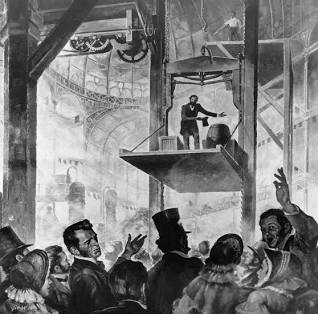
Promoted by the famous showman P.T. Barnum, Otis stood on an open elevator platform hoisted high above the exhibition floor, surrounded by heavy barrels and cargo. In front of a gasping crowd, he ordered an assistant to slash the main hoisting rope with an axe. Instead of plunging to the ground, the platform dropped only a few inches before the safety spring engaged, halting the descent. Otis reportedly tipped his hat and announced to the relieved crowd, “All safe, gentlemen, all safe.”
Orders for his elevators immediately surged following the demonstration.
Legacy and Impact
On March 23, 1857, Otis installed the world’s first commercial passenger safety elevator in the five-story E.V. Haughwout Building in New York City. Powered by a steam engine, it traveled at a speed of 40 feet per minute.
Otis died of diphtheria in 1861 at the age of 49, before he could witness the full architectural revolution his invention spurred. His sons, Charles and Norton, took over the business, securing its patents and growing the Otis Elevator Company into a global powerhouse. Without Otis’s safety brake, the vertical expansion of cities—and the invention of the skyscraper—would have been practically impossible.
Key Milestones
- Birth
1811
Born on August 3 in Halifax, Vermont. - The Safety Brake
1852
Invents the elevator safety mechanism while working at a bedstead factory in Yonkers, NY. - Company Founded
1853
Sells his first freight elevator and establishes the business that would become the Otis Elevator Company. - Crystal Palace Exhibition
1854
Dramatically proves his invention’s reliability by cutting the hoisting rope while standing on the suspended platform. - First Passenger Elevator
1857
Installs the first commercial passenger safety elevator at the E.V. Haughwout Building in New York City. - Death
1861
Patents an independently controlled steam engine for elevators; dies on April 8 in Yonkers.