Before 1921, a diagnosis of Type 1 diabetes was essentially a death sentence. The only known treatment was a strict starvation diet that only delayed the inevitable. The discovery and isolation of insulin by a team at the University of Toronto remains one of the most significant medical breakthroughs of the 20th century.
The Challenge
By the early 1900s, scientists knew that diabetes was linked to the pancreas, specifically to clusters of cells known as the islets of Langerhans. They hypothesized that these islets produced an internal secretion (already named “insulin” in theory) that regulated blood sugar.
However, every attempt to extract this substance failed. The pancreas also produces potent digestive juices. When scientists ground up the pancreas to extract insulin, these digestive enzymes destroyed the delicate hormone before it could be isolated.
A Team of Four
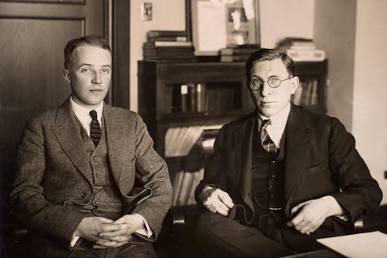
The breakthrough was not the work of a single inventor, but a collaborative effort by four key figures at the University of Toronto:
- Dr. Frederick Banting: A Canadian surgeon with little research experience but a brilliant idea for how to bypass the digestive enzymes.
- Charles Best: A 22-year-old medical student and research assistant, specialized in testing blood to check glucose levels.
- Professor John J.R. Macleod: A leading expert in carbohydrate metabolism who provided Banting with laboratory space, dogs for experimentation, and scientific guidance.
- James B. Collip: A biochemist brought in late in the process whose expertise was crucial for purifying the crude extract so it could safely be injected into humans.
Key Milestones in the Discover
The Hypothesis (October 1920)
Banting read a medical paper and realized that by surgically tying off the pancreatic ducts in dogs, the digestive-enzyme-producing cells would die off, leaving the islets of Langerhans intact to safely harvest the insulin.
Laboratory Success (Summer 1921)
Working in Macleod’s lab, Banting and Best successfully extracted the hormone from dogs and injected it into other dogs with induced diabetes, observing significant drops in blood sugar levels.
Purification (December 1921)
Realizing their extract was too impure and toxic for human use, Macleod brought in James Collip. Collip developed a method using alcohol concentrations to precipitate and purify the active ingredient from the pancreases of cattle.
First Human Patient (January 1922)
5Leonard Thompson, a 14-year-old boy dying of diabetes and weighing just 65 pounds, received the first injection. The initial dose caused an allergic reaction, but after Collip worked tirelessly to refine the purity, a second injection on January 23 was a complete success, dropping the boy’s blood sugar to normal levels.
The Nobel Prize (1923)
Banting and Macleod were awarded the Nobel Prize in Physiology or Medicine. Outraged that Best was excluded, Banting publicly shared half his prize money with Best. Macleod subsequently shared half of his with Collip.
How Insulin Works
The hormone they isolated operates as the body’s primary metabolic regulator. This overview breaks down the precise mechanism of how insulin interacts with cells to manage blood glucose:
Key insight: Banting and his team chose not to profit off the discovery. In 1923, they sold the patent rights to the University of Toronto for a mere $1 each, famously declaring, “Insulin does not belong to me, it belongs to the world.”