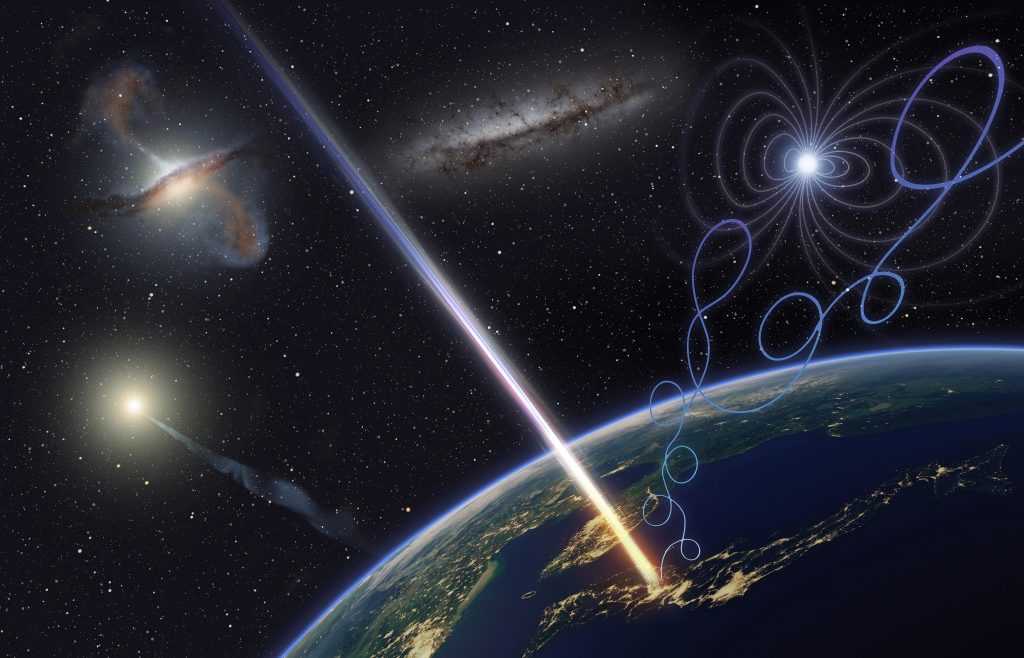
The “Oh-My-God” Particle is the nickname given to one of the most energetic particles ever detected in the history of science. It struck Earth’s atmosphere on October 15, 1991, carrying an astonishing amount of energy—far more than scientists believed was common in nature.
Although it is called a “particle,” it was most likely a single proton (the positively charged particle found inside every atom), although some scientists have suggested it may have been a heavier atomic nucleus.
The particle was detected by the Fly’s Eye Detector, an observatory built specifically to study high-energy particles arriving from outer space.
Scientists were so amazed by the calculated energy that the event quickly became legendary, eventually earning the nickname “Oh-My-God” Particle because of the extraordinary result.
Today, the event remains one of the greatest mysteries in astrophysics.
Quick Facts
| Fact | Information |
|---|---|
| Nickname | Oh-My-God Particle |
| Detection Date | October 15, 1991 |
| Detector | Fly’s Eye Detector |
| Likely Particle | Proton (possibly a heavier nucleus) |
| Estimated Energy | About 320 exa-electronvolts (EeV) |
| Energy in Joules | Approximately 51 joules |
| Speed | More than 99.99999999999999999999995% the speed of light |
| Scientific Category | Ultra-high-energy cosmic ray |
Why Is It Famous?
Every second, billions of tiny particles pass through your body without causing harm.
Most carry very little energy.
The Oh-My-God Particle was different.
It contained roughly the same amount of kinetic energy as:
- A baseball moving around 90–100 km/h (55–60 mph)
- A tennis ball dropped from shoulder height
That may not sound extraordinary until you realize something astonishing:
All of that energy was packed into a single subatomic particle.
Normally, a proton carries an incredibly tiny amount of energy. This proton carried millions of millions of times more energy than particles produced in most laboratory experiments.

What Are Cosmic Rays?
Before understanding the Oh-My-God Particle, it helps to understand cosmic rays.
Despite the name, cosmic rays are not actually rays of light.
They are high-speed particles traveling through space.
- Protons (about 90%)
- Helium nuclei
- Heavier atomic nuclei
- Occasionally electrons
They constantly bombard Earth from every direction.
Where Do Cosmic Rays Come From?
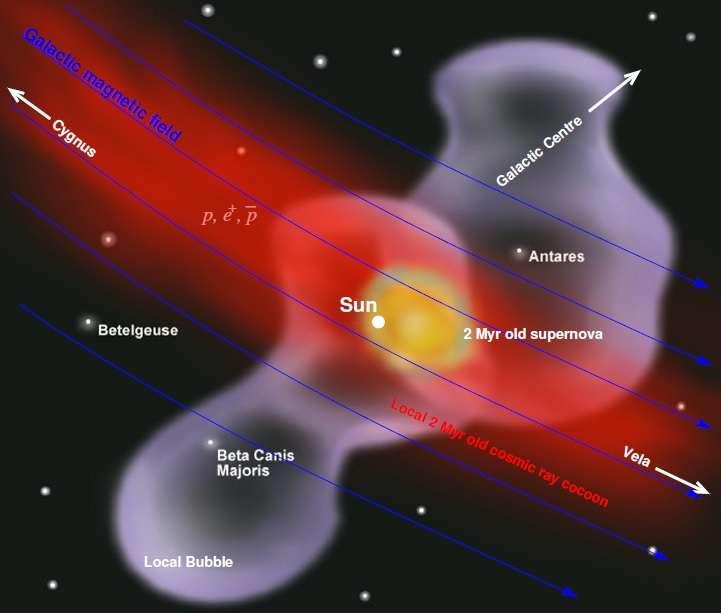
Scientists believe cosmic rays originate from several types of powerful astronomical events.
Possible sources include:
- Supernova explosions
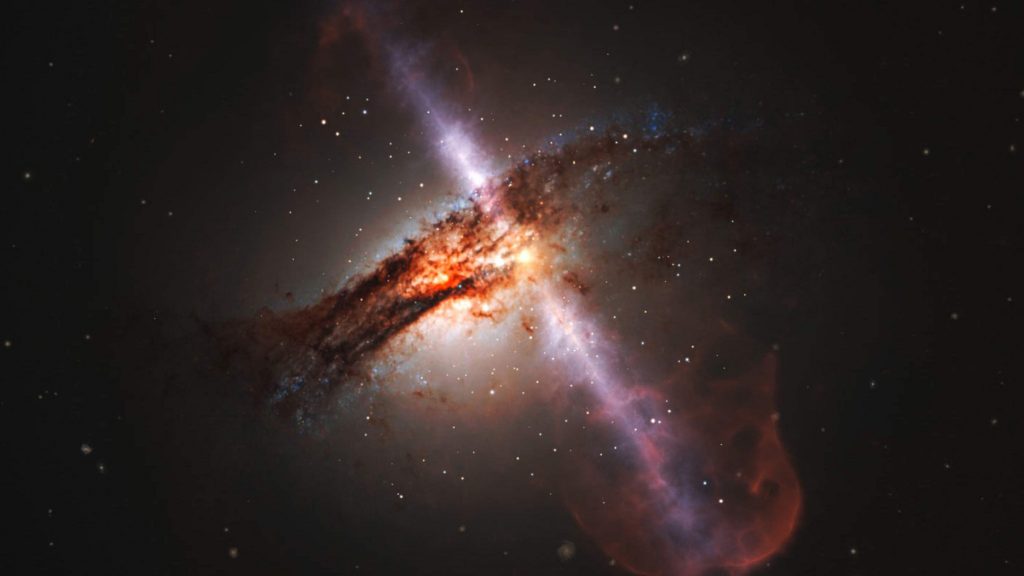
- Black hole jets
- Active galactic nucleus
- Collisions between galaxies
- Gamma-ray bursts
- Magnetars
- Unknown extreme cosmic accelerators
Most cosmic rays have moderate energies.
Only an incredibly tiny fraction become ultra-high-energy cosmic rays (UHECRs).
The Oh-My-God Particle belongs to this rare category.
The Discovery
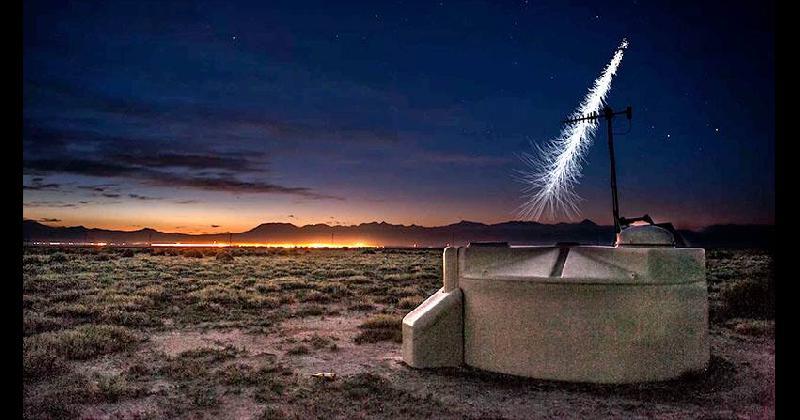

On the night of October 15, 1991, the Fly’s Eye Detector observed something extraordinary.
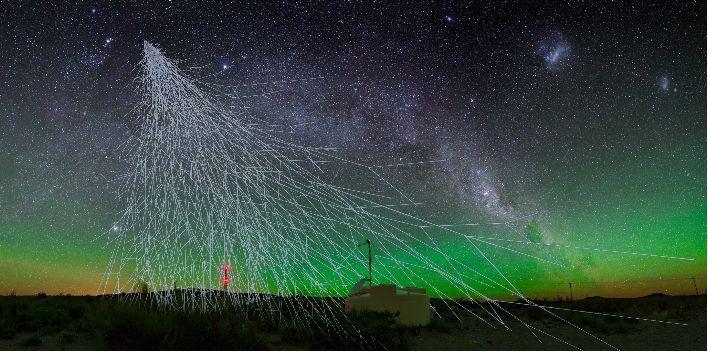
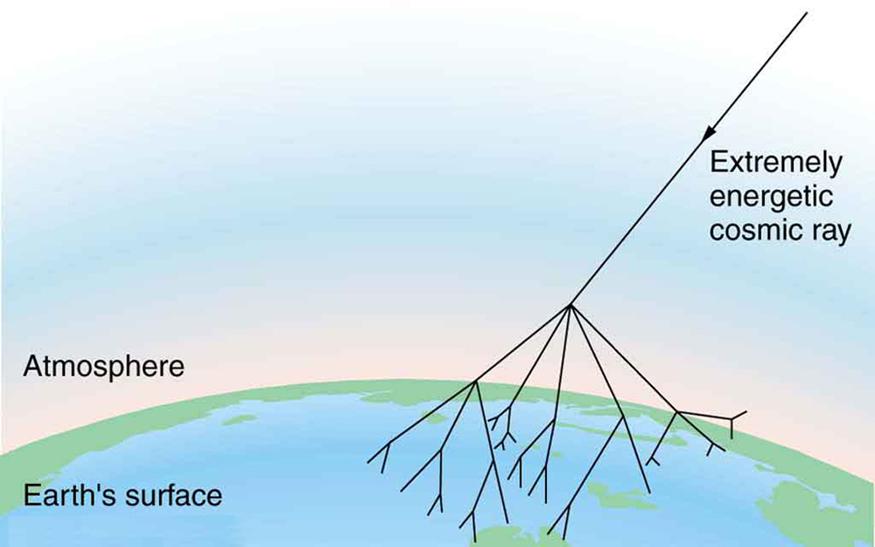
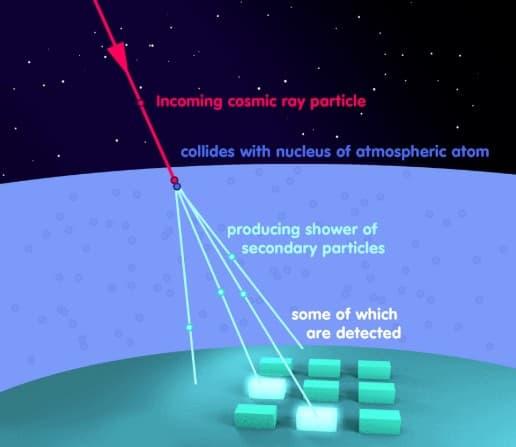
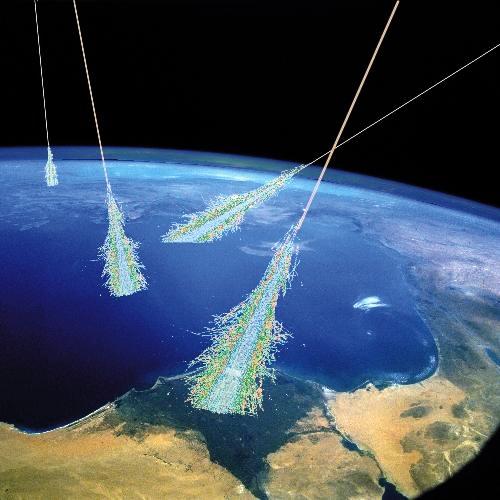
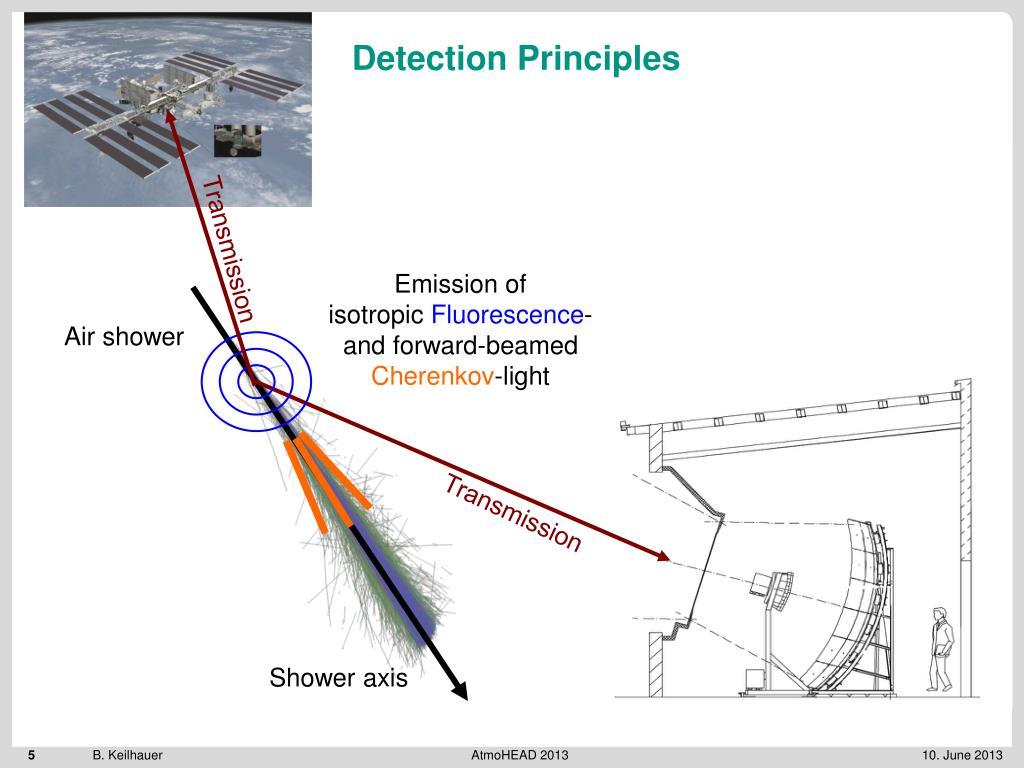
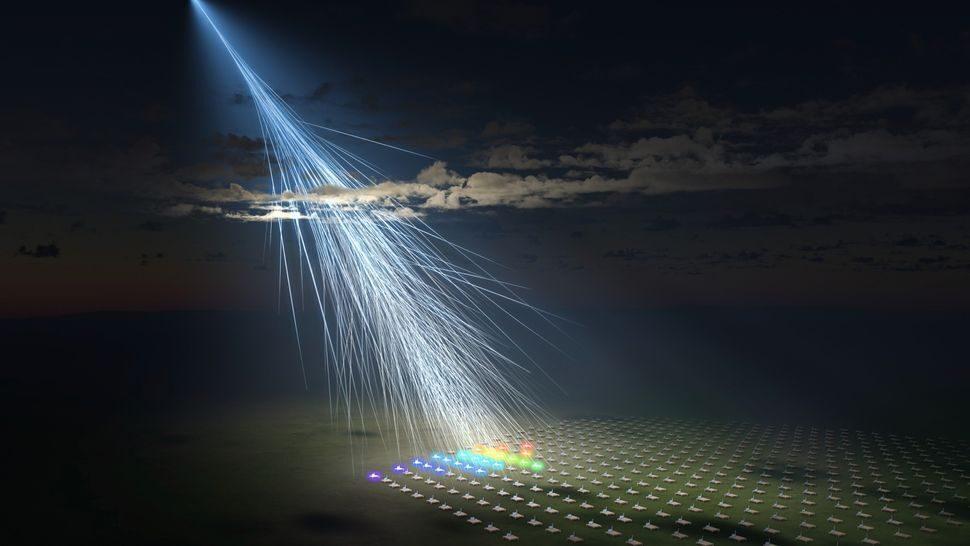
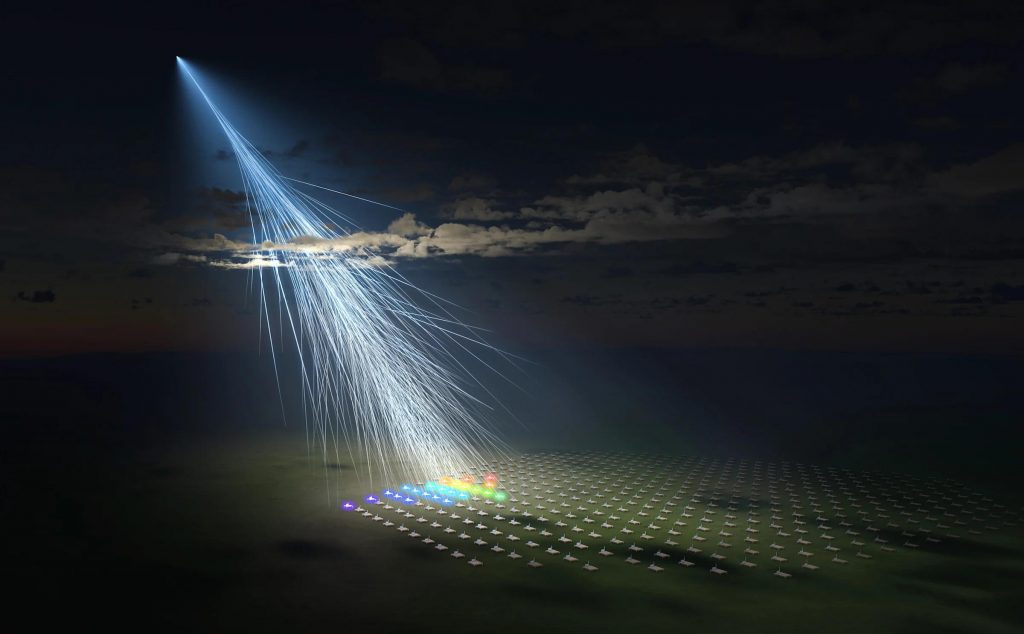
Instead of detecting the particle directly, scientists detected the enormous cascade of secondary particles it created after striking Earth’s atmosphere.
This cascade is known as an extensive air shower.
What Happens During an Air Shower?
Imagine throwing a bowling ball into a stack of glass plates.
One impact creates thousands of fragments.
Similarly:
- The cosmic ray enters the atmosphere.
- It collides with an air molecule.
- New particles are created.
- Those particles create even more collisions.
- Eventually, billions of particles spread across several square kilometers.
The detector observed the faint ultraviolet glow produced during this process.
Using sophisticated calculations, scientists reconstructed the original particle’s energy.
The answer was astonishing.
How Much Energy Did It Have?
3.2 × 10²⁰ electronvolts
That equals approximately:
51 joules
For comparison:
| Object | Approximate Energy |
|---|---|
| Mosquito in flight | Much less |
| Snowflake falling | Much less |
| Tennis ball dropped | Similar |
| Baseball pitch | Similar |
Again:
Those 51 joules belonged to one single proton-sized particle.
Compared to Particle Accelerators
The world’s largest particle accelerator is the Large Hadron Collider.
Even today, the LHC accelerates particles to energies of about 6.8–7 tera-electronvolts (TeV) per proton beam.
The Oh-My-God Particle carried tens of millions of times more energy per particle than a single proton in the LHC.
This is one reason scientists are fascinated by cosmic rays: nature can accelerate particles far beyond what humans currently achieve in laboratories.
How Fast Was It?
According to calculations, the particle traveled at:
99.99999999999999999999995% of the speed of light
Even though this sounds incredible, it was not actually moving faster than light.
Nothing with mass can exceed the speed of light.
Instead, it had such enormous energy that its speed differed from light by only an unimaginably tiny amount.
If light raced around Earth, this proton would arrive only a tiny fraction of a second later—even after traveling immense distances through space.
Where Did It Come From?
This remains one of the greatest unanswered questions.
Scientists traced the incoming direction as well as possible, but no obvious source was found.
Possible explanations include:
- An extremely distant galaxy
- A giant black hole
- A powerful active galaxy
- A gamma-ray burst
- A previously unknown astronomical object
Some researchers have even proposed that unusual physics beyond current models might be involved, but there is no convincing evidence for exotic explanations.
The true origin remains unknown.
The GZK Limit
One of the biggest puzzles involves something called the Greisen–Zatsepin–Kuzmin limit (often abbreviated GZK limit).
This theoretical limit predicts that cosmic rays with extremely high energies should lose energy by interacting with the faint background light that fills the universe, known as the Cosmic microwave background.
Because of this, particles with energies as high as the Oh-My-God Particle are expected to come only from relatively nearby cosmic sources—within roughly 100–200 million light-years. Yet no obvious nearby source aligns with the particle’s arrival direction.
This tension between theory and observation is one reason the event became so famous.

Modern Research
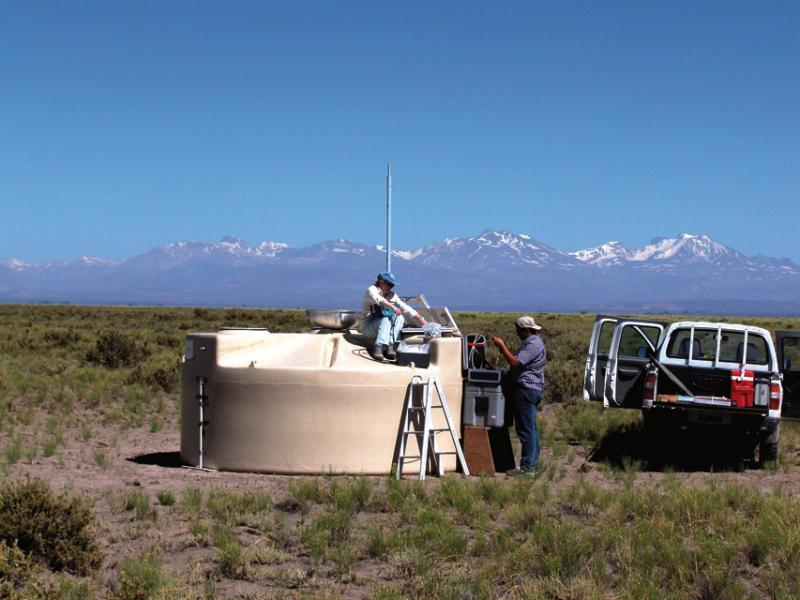
Since 1991, scientists have built much larger observatories to study ultra-high-energy cosmic rays.
- Pierre Auger Observatory
- Telescope Array Project
These observatories have detected additional ultra-high-energy cosmic rays, although none has become as iconic as the original Oh-My-God Particle. Researchers continue to study their energies, compositions, and arrival directions to identify the cosmic accelerators responsible.
Why Scientists Still Study It?
The Oh-My-God Particle helps scientists investigate:
- The most powerful natural particle accelerators in the universe
- The physics of extreme energies
- The origin of cosmic rays
- The structure and magnetic fields of the universe
- Whether current theories of particle physics remain accurate at the highest observed energies
Each new detection provides another clue about these fundamental questions.
Fun Facts
- Only one Oh-My-God Particle event has given rise to this famous nickname.
- Similar ultra-high-energy cosmic rays have been observed since then, but they remain exceedingly rare.
- Billions of ordinary cosmic rays strike Earth every second, while events at this energy occur only occasionally over very large detector areas.
- The particle’s journey may have begun millions of years before it reached Earth.
- It likely traveled across intergalactic space before finally colliding with our atmosphere.
Glossary
Cosmic Ray — A high-energy particle arriving from space.
Proton — A positively charged particle found inside atomic nuclei.
Electronvolt (eV) — A unit used to measure the energy of tiny particles.
Exa-electronvolt (EeV) — One quintillion (10¹⁸) electronvolts.
Ultra-High-Energy Cosmic Ray (UHECR) — A cosmic ray with extraordinarily high energy, typically above about 1 EeV.
Extensive Air Shower — The enormous cascade of secondary particles created when a cosmic ray strikes Earth’s atmosphere.
Speed of Light — Approximately 299,792 kilometers per second (186,282 miles per second), the fastest speed at which information can travel according to current physics.
Summary
The Oh-My-God Particle remains one of the most extraordinary natural events ever recorded in particle astrophysics. A single subatomic particle, probably a proton, arrived at Earth with an energy of about 320 EeV, far exceeding the energies routinely achieved in human-made accelerators. Detected in 1991 by the Fly’s Eye Detector, it challenged scientists’ understanding of how nature can accelerate particles to such extreme energies and where such particles originate.
More than three decades later, the event continues to inspire research into cosmic rays, extreme astrophysical environments, and the fundamental laws governing the universe. Although many questions remain unanswered, the Oh-My-God Particle stands as a striking reminder that the cosmos still holds phenomena beyond our full understanding.