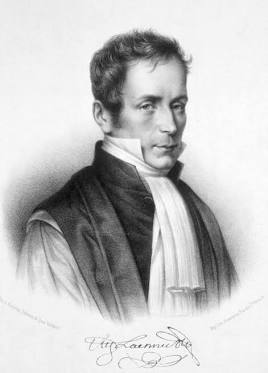
René-Théophile-Hyacinthe Laennec (1781–1826) was a pioneering French physician. While he made several major contributions to medicine—including being the first to recognize melanoma as a metastatic cancer and naming cirrhosis of the liver—he is most famous for inventing the stethoscope and fundamentally changing how doctors diagnose illness.
The Problem: “Immediate Auscultation”
Before 1816, doctors listened to a patient’s heart and lungs by placing their ear directly against the patient’s chest—a practice known as “immediate auscultation.” This method had two major flaws:
- It was socially awkward: It required intimate physical contact, which was often uncomfortable or inappropriate for both the doctor and the patient.
- It was medically ineffective: If a patient carried excess body weight, the layers of fat muffled the internal sounds, making it nearly impossible to hear the heart or lungs clearly.
The “Aha!” Moment
In 1816, Laennec was consulted by a young woman showing symptoms of heart disease. Because she carried extra weight, tapping on her chest to listen for resonance was ineffective. Because of her age and sex, placing his ear directly on her chest was out of the question.
Drawing on his knowledge of acoustics—specifically how scratching one end of a piece of wood amplifies the sound at the other end—he rolled a stack of paper into a tight cylinder. He placed one end against her chest and the other to his ear. To his amazement, the heart sounds were not just clearer, but significantly louder and more distinct than they would have been with a direct ear-to-chest examination.
Perfecting the Design
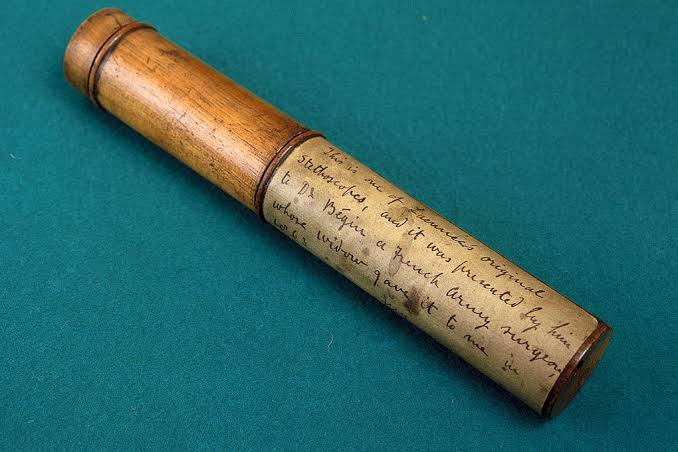
Realizing he had stumbled onto something revolutionary, Laennec spent the next few years perfecting his improvised paper tube. He eventually transitioned to crafting hollow wooden cylinders, usually made of cedar or ebony, that measured about 25 centimeters long and could be disassembled into pieces for easy carrying.
He named his new instrument the stethoscope, combining the Greek words stethos (chest) and skopein (to view or examine).
A Tragic Irony
Laennec’s simple wooden tube completely transformed medicine. It shifted the profession from merely observing outward symptoms to actively listening to the internal workings of the body. Using his new tool, he wrote the first definitive diagnostic descriptions of respiratory conditions like pneumonia, emphysema, and tuberculosis.
Tragically, his dedication to studying chest diseases cost him his life. Laennec died at the age of 45 from tuberculosis—the very disease his invention helped doctors learn to identify.
The Invention that Revolutionized Medicine
This video provides a great visual history of how Laennec’s simple rolled-up piece of paper evolved into the modern diagnostic tool used by doctors today.