Robert Hutchings Goddard
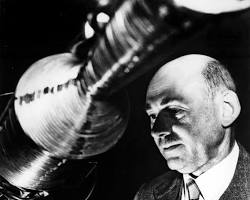
Robert Hutchings Goddard (October 5, 1882 – August 10, 1945) was an American physicist, engineer, and inventor who is widely recognized as the father of practical modern rocketry. He is credited with building and launching the world’s first liquid-fueled rocket. Although his groundbreaking work received little public or governmental support during his lifetime—and often faced ridicule from the press—his theories and inventions laid the critical foundation for the Space Age, ballistic missiles, and space exploration.
Early Life and Inspiration
Goddard was born in Worcester, Massachusetts. His fascination with space and rocketry began early in his life, heavily influenced by science fiction.
- On October 19, 1899, while climbing a cherry tree to prune branches, the 17-year-old Goddard had a transformative daydream about inventing a device capable of ascending to Mars.
- He later reflected that this vision made his life seem purposeful, and it drove his ambition to make spaceflight a practical reality.
- His education was delayed by chronic illness; he graduated high school at age 21 and was later diagnosed with tuberculosis in 1913, though he persevered to continue his research.
- Goddard earned his PhD in physics from Clark University in 1911 and eventually became the head of its physics department.
Pioneering Rocketry and Inventions
Goddard’s contributions to rocketry moved the field from theoretical speculation to physical engineering. He proved that rockets could provide thrust in a vacuum, demonstrating that they did not need air to push against in order to operate. In 1919, he published a foundational monograph titled A Method of Reaching Extreme Altitudes, which outlined the mathematical theories of rocketry and detailed his early experiments.
“It is difficult to say what is impossible, for the dream of yesterday is the hope of today and the reality of tomorrow.” — Robert H. Goddard
The First Liquid-Fueled Rocket
Before Goddard, rockets relied on solid fuels, but Goddard saw that liquid propellants could provide the sustainability and control required for space travel.
- Date: March 16, 1926.
- Location: Aunt Effie’s farm (Asa Ward Farm) in Auburn, Massachusetts.
- Flight Data: The 10-foot rocket, nicknamed “Nell,” burned a mixture of liquid oxygen and gasoline. It flew for 2.5 seconds, reaching an altitude of 41 feet and landing 184 feet away.
- Significance: Though a modest flight, it was a pivotal breakthrough demonstrating that liquid-fueled rockets worked, marking a turning point in the history of space exploration.
Roswell Experiments and Key Technologies
Seeking a safer and larger space for his experiments, Goddard relocated to Roswell, New Mexico, in 1930 with funding secured by aviator Charles Lindbergh from the Guggenheim Foundation. Between 1926 and 1941, Goddard and his team launched 34 rockets, achieving altitudes up to 2.6 kilometers and speeds over 800 kilometers per hour.
During this period, he developed several foundational aerospace technologies:
| Innovation | Description |
| Multi-stage Rockets | Patented in 1914, this concept allowed rockets to shed weight as they ascended. |
| Gyroscopic Control | Invented a guidance system using gyroscopes and steerable vanes in the rocket’s exhaust to control flight paths. |
| Film Cooling | A method of using the liquid rocket fuel to cool the combustion chamber and prevent it from melting, still used in modern engines. |
| Scientific Instrumentation | The first to equip a rocket with scientific instruments, including a barometer and thermometer, in 1929. |
Legacy
Despite his monumental achievements, Goddard operated in high secrecy due to a lack of vision from official channels and harsh ridicule from the public press. His patents and practical designs, however, were heavily studied by German engineers who incorporated them into the V-2 rocket during World War II. Today, Goddard holds 214 patents (many filed posthumously by his wife, Esther Goddard) and is celebrated universally as the man who ushered in the Space Age. He was posthumously awarded the Congressional Gold Medal in 1959.