Joseph Farwell Glidden (1813–1906) was the American farmer-entrepreneur whose refined design and mass production of barbed wire reshaped the landscape, economy, and social order of the nineteenth-century United States.
Early Life
Born in 1813, Joseph Glidden grew up in a rural, agrarian world that demanded practical ingenuity. After years of teaching and farming, he settled in DeKalb, Illinois, where the challenge of fencing vast, windswept prairies with scarce timber would define his legacy.
The Problem Barbed Wire Solved
Before the 1870s, fencing the treeless Great Plains was prohibitively expensive. Split-rail fences required timber that was rare and costly on the prairie; smooth wire could not reliably deter livestock. Farmers, ranchers, and railroads needed a fence that was durable, affordable, easy to install, and effective at containing cattle and protecting crops.
Inventing a Better Barb
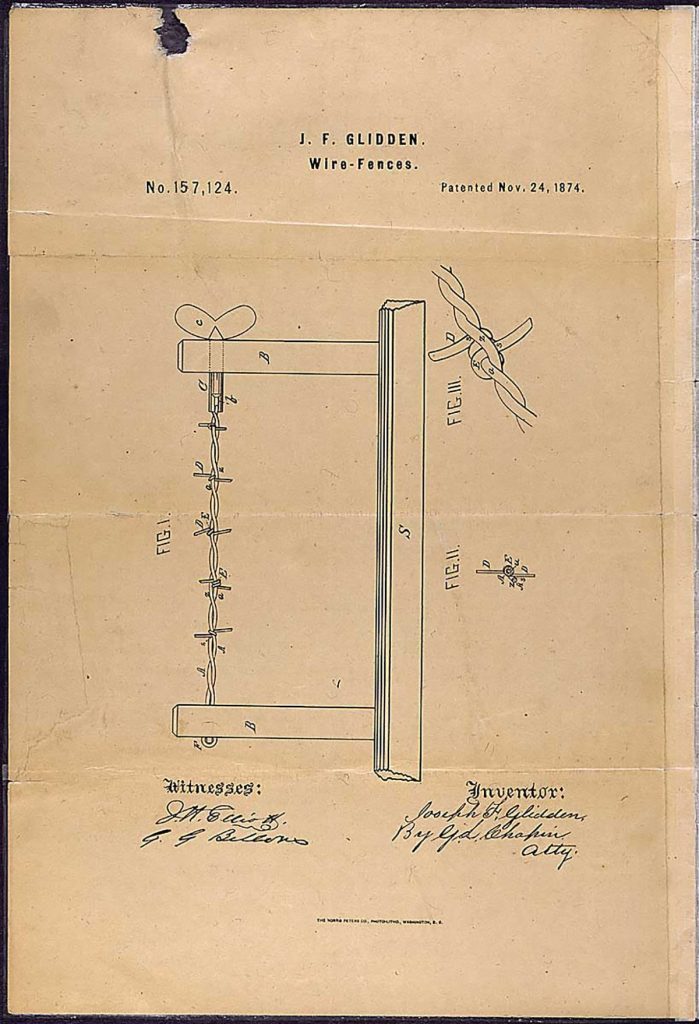
Glidden’s breakthrough was simple and elegant: short, sharp barbs locked between two twisted strands of wire so they would not slide. He famously fashioned early barbs with a modified coffee mill and devised a jig to twist the line wires, creating a rugged, repeatable design suited to mass production.
He filed his application in 1873 and received U.S. Patent No. 157,124 on November 24, 1874, for an “Improvement in Wire Fences.” His most successful product became known as The Winner, a double-strand wire with fixed barbs that balanced strength, flexibility, and manufacturability.
Building an Industry
Recognizing the scale of the opportunity, Glidden partnered with fellow DeKalb entrepreneur Isaac L. Ellwood to form a manufacturing and distribution base. He also entered strategic agreements with the Washburn & Moen Manufacturing Company of Worcester, Massachusetts, unlocking nationwide production and sales. Within a few years, barbed wire moved from novelty to necessity across farms and ranches.
Patent Battles and Recognition
Barbed wire’s commercial promise sparked intense competition and litigation. Rivals including Jacob Haish and others claimed priority, and courts across the country weighed in. Ultimately, key decisions upheld the novelty and enforceability of Glidden’s approach, affirming his role as the principal architect of the market-dominant design.
Transforming the American West
- Property and Settlement: Affordable fencing enabled homesteaders to protect crops, clarify boundaries, and invest in land improvements, accelerating settlement and agricultural productivity.
- Ranching Revolution: Barbed wire made large-scale, controlled grazing practical, reshaping cattle operations and logistics from Texas to the Dakotas.
- Conflict and Consequence: The end of the open range triggered “fence-cutting” conflicts, particularly in Texas, and contributed to profound changes for Indigenous peoples and traditional cattle trails.
- Global Reach: Beyond agriculture, barbed wire saw military and industrial uses, foreshadowing its widespread deployment in fortifications by the early twentieth century.
Business Ventures and Later Life
Glidden leveraged barbed-wire profits into land and livestock ventures, including major holdings in the Texas Panhandle developed with his son-in-law, Henry B. Sanborn. In DeKalb, he invested in civic and educational initiatives and helped position the city as a manufacturing hub. Despite wealth and national renown, he maintained the practical outlook of a farmer-inventor.
Death and Legacy
Joseph Glidden died in DeKalb, Illinois, in 1906. His legacy endures in the everyday lines that crisscross fields and pastures and in the economic geography of the Great Plains. More than a clever hardware innovation, his barbed wire catalyzed a new era of land use, property rights, and rural modernization—changes that reverberated far beyond the American West.
Key Dates
- 1813: Born
- 1873: Files application for barbed-wire improvement
- 1874: Awarded U.S. Patent No. 157,124; begins large-scale production
- 1880s: Barbed wire becomes the dominant fencing across the Plains
- 1906: Dies in DeKalb, Illinois
Joseph Glidden’s practical genius lay in perfecting a simple device and building the systems to manufacture and sell it at scale. In doing so, he helped draw the literal lines that defined modern American agriculture.