James Hargreaves (c. 1720–1778)
James Hargreaves was an English weaver and inventor best known for creating the spinning jenny, a landmark innovation that transformed textile production during the early Industrial Revolution.
Early Life
Hargreaves was born around 1720 in Oswaldtwistle, Lancashire, England. He worked as a hand-loom weaver and carpenter, occupations common in the region’s domestic textile industry.
Invention of the Spinning Jenny
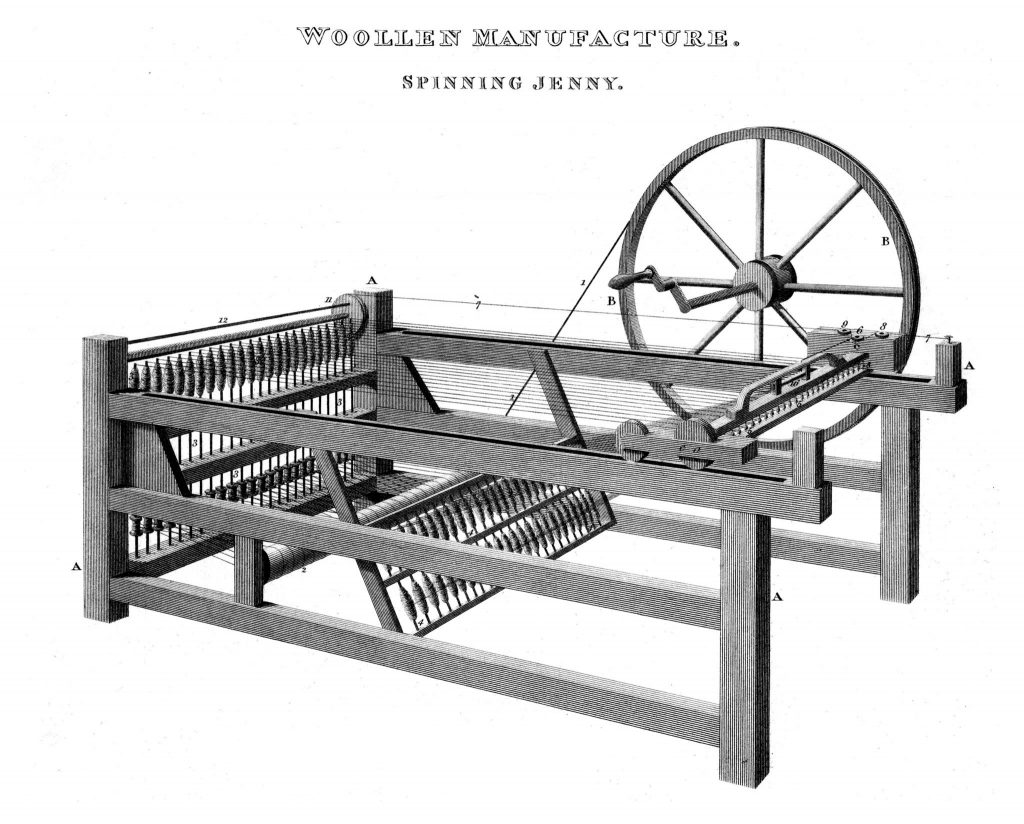
Around 1764, Hargreaves devised the spinning jenny, a multi-spindle spinning frame that enabled one worker to spin several threads simultaneously by turning a single wheel. He received a British patent in 1770. Early models carried eight spindles; later versions expanded to dozens, dramatically increasing yarn output.
The jenny was particularly effective for producing weft yarn, though its thread was generally not strong enough for warp, a limitation later addressed by other technologies. The name “jenny” is often said to derive from “engine,” though its exact origin remains debated.
Resistance and Relocation
The machine’s labor-saving power provoked hostility among hand spinners. In the late 1760s, anti-machine riots in Lancashire targeted Hargreaves and destroyed jennies. He subsequently moved to Nottingham, where he continued manufacturing and selling the machines in collaboration with local textile interests.
Impact and Legacy
Hargreaves’s spinning jenny was a pivotal step in mechanizing spinning, vastly boosting productivity in the cotton industry and accelerating the shift from domestic to factory-based production. Alongside innovations such as John Kay’s flying shuttle, Richard Arkwright’s water frame, and Samuel Crompton’s mule, the jenny helped establish the technological foundation of the Industrial Revolution.
Death
James Hargreaves died in Nottingham on 22 April 1778. He is remembered as a key figure in industrial history whose invention reshaped textile manufacturing and labor patterns in 18th-century Britain.