John Wesley Hyatt (1837–1920)
John Wesley Hyatt was an American inventor best known for pioneering celluloid, the first widely used synthetic plastic, and for establishing key techniques in mass plastics manufacturing.
Early Life
Born on November 28, 1837, in Starkey, New York, Hyatt trained as a printer and developed a lifelong interest in materials and mechanical innovation.
Celluloid and Plastics Innovation
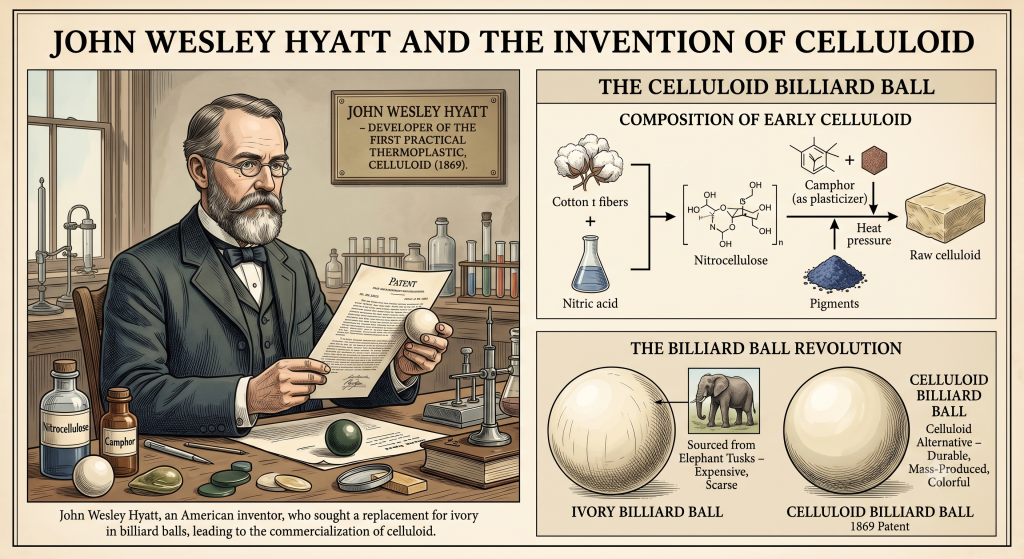
Seeking a substitute for ivory in billiard balls, Hyatt—working with his brother Isaiah—advanced earlier nitrocellulose research by discovering that camphor effectively plasticized collodion (pyroxylin). He patented a process for molding this material in 1869–1870 and coined and later trademarked the name “celluloid.” Durable, moldable, and comparatively inexpensive, celluloid enabled mass production of items such as combs, shirt collars and cuffs, piano keys, toys, and knife handles, and it provided a flexible film base crucial to the rise of photography and motion pictures.
Hyatt also patented the first practical injection molding machine in 1872, laying the groundwork for one of the most important industrial manufacturing processes of the 20th century.
Business Ventures
He founded the Albany Billiard Ball Company to commercialize celluloid billiard balls and, with Isaiah, established the Celluloid Manufacturing Company in Newark, New Jersey, in the early 1870s to produce celluloid in bulk. Over his career he amassed more than 200 patents spanning plastics and mechanical devices.
Beyond plastics, Hyatt developed the flexible Hyatt roller bearing and helped form the Hyatt Roller Bearing Company, which became a significant automotive supplier and was later incorporated into General Motors.
Legacy
Hyatt’s work reduced reliance on scarce natural materials such as ivory, horn, and tortoiseshell, propelled the growth of affordable consumer goods, and enabled photographic and cinematographic technologies. Often regarded as a founder of the modern plastics industry, he died on May 10, 1920, in Short Hills, New Jersey.