Mikhail Kalashnikov and the AK-47 Rifle
An overview of the Soviet designer Mikhail Timofeyevich Kalashnikov and the development, characteristics, and global impact of the AK-47 rifle and its derivatives.
Mikhail Kalashnikov: Biography
Mikhail Timofeyevich Kalashnikov (1919–2013) was a Russian/Soviet engineer, soldier, and small-arms designer best known for creating the AK-47 assault rifle. Born in Kurya, Altai Krai, in a peasant family that suffered during collectivization, Kalashnikov was conscripted into the Red Army in 1938 and served as a tank mechanic and later as a tank commander during the Second World War. Wounded in 1941, he used his convalescence to pursue weapon design ideas, motivated by a desire to improve the Red Army’s small arms reliability and ergonomics.
Through the 1940s, Kalashnikov worked at design bureaus and proving grounds, refining prototypes that culminated in a winning submission to the Soviet trials for a new intermediate-cartridge rifle. The resulting design, formally adopted in 1949 as the Avtomat Kalashnikova (AK), became the foundation of a long lineage of firearms. Kalashnikov spent much of his career at the Izhevsk Mechanical Plant (later Izhmash, now Kalashnikov Concern), rising to chief designer. He received numerous state honors, including the titles Hero of Socialist Labor and Hero of the Russian Federation. He died in Izhevsk in 2013.
Development of the AK-47
The AK-47 emerged from Soviet efforts to field a reliable, selective-fire infantry weapon chambered for an intermediate cartridge, the 7.62×39 mm round developed during the early 1940s. Postwar evaluations emphasized ruggedness, ease of mass production, and effective performance at typical combat ranges.
- 1944–1946: Experiments across multiple design teams on rifles for the 7.62×39 mm cartridge.
- 1946–1947: Kalashnikov’s prototype refined through trials; features included a long-stroke gas piston and rotating bolt.
- 1949: Formal Soviet adoption as the Avtomat Kalashnikova (AK). Early production featured milled receivers after initial stamped designs proved challenging.
- 1959: Introduction of the lighter, improved AKM, returning to a stamped receiver and incorporating manufacturing simplifications.
Over subsequent decades, the basic system evolved but retained its hallmark emphasis on reliability under adverse conditions.
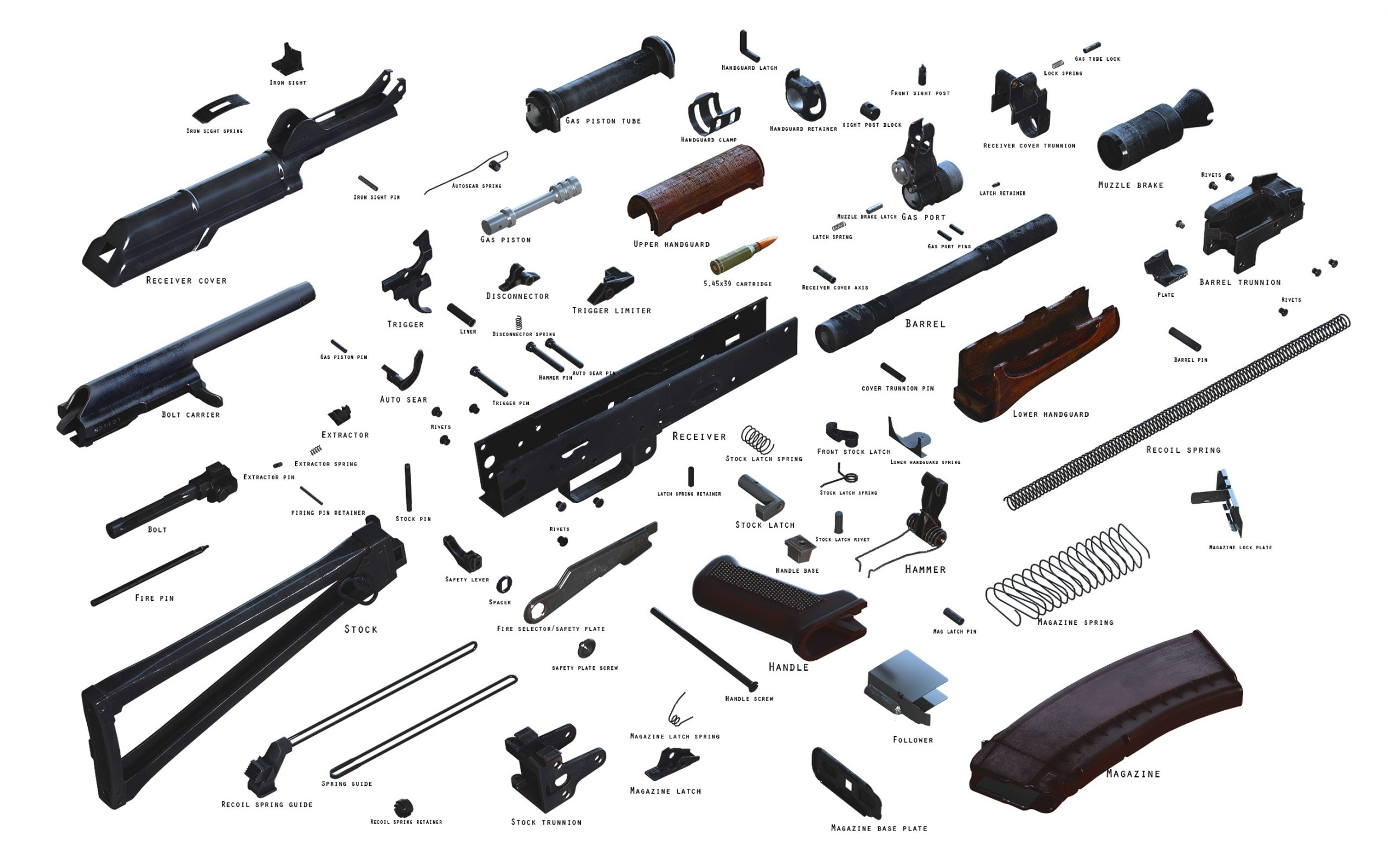
Design Characteristics and Operation
The AK-47 is a gas-operated, magazine-fed rifle using a long-stroke piston and a rotating, two-lug bolt. Its design prioritizes tolerance to dirt and debris, functional simplicity, and manufacturability.
- Cartridge: 7.62×39 mm (original AK and AKM); later family variants include 5.45×39 mm (AK-74 series) and 5.56×45 mm NATO (export models).
- Action: Gas-operated, long-stroke piston with rotating bolt.
- Feed system: Detachable curved box magazine, commonly 30 rounds.
- Construction: Mix of steel, wood or polymer furniture, and stamped or milled receivers depending on the variant and era.
- Attributes: Robustness, tolerance to harsh environments, and straightforward field maintenance were central design goals.
While not designed for precision marksmanship at extended ranges, the platform is optimized for reliability and adequate accuracy at typical infantry engagement distances.
Production, Variants, and Derivatives
The AK family is among the most widely produced small-arms systems in history, with tens of millions manufactured worldwide under license and, in some cases, without formal authorization. Notable variants include:
- AK (Type 1–3): Early models with developmental changes in receiver construction.
- AKM (1959): Lighter stamped receiver, improved manufacturing methods, and updated components.
- AK-74 series (from 1974): Chambered in 5.45×39 mm; includes AK-74M with modernized features.
- AK-100/200 series and AK-12: Later Russian evolutions with updated materials, ergonomics, and accessory compatibility.
- RPK light machine gun: Squad automatic weapon based on the AK mechanism with a longer barrel and strengthened receiver.
- International derivatives: Numerous national patterns produced in countries such as China, Poland, Romania, Bulgaria, Egypt, and others.
Manufacturing approaches evolved from early milling to widespread stamping and spot welding, enabling rapid, cost-effective production.
Global Proliferation and Impact
The AK-47 and its derivatives became globally prominent during the Cold War, distributed to allied states and liberation movements. Their durability, relative affordability, and ubiquity made them fixtures in armed forces and irregular groups across multiple continents.
The rifle’s silhouette has become a political and cultural symbol—appearing on national flags (notably Mozambique) and in emblems, films, literature, and popular culture. This notoriety reflects both its technical success and its association with revolutionary movements, decolonization struggles, and numerous conflicts.
Analysts and humanitarian organizations have noted the human cost associated with the widespread availability of small arms, including Kalashnikov-pattern rifles. Debates continue over arms proliferation, export controls, and post-conflict disarmament, in which the AK family features prominently as a case study.
Service History
Since its adoption, the AK platform has seen service in military and paramilitary roles across Asia, Africa, the Middle East, Europe, and the Americas. Its operational record spans conventional wars, insurgencies, and peacekeeping environments. The platform’s longevity in service reflects the combination of manufacturing scale, logistical familiarity, and functional resilience.
Industry, Licensing, and Economics
Within the Soviet Union and Russia, production centered on facilities in Izhevsk and Tula, with Izhmash (now part of Kalashnikov Concern) as a principal manufacturer. Internationally, licensed and unlicensed production has occurred in numerous countries, contributing to global availability and market diversity. Intellectual property and licensing disputes have occasionally arisen, especially after the dissolution of the Soviet Union.
Legal and Civilian Context
Laws governing possession, trade, and configuration of AK-pattern rifles vary widely by jurisdiction, with distinctions between military selective-fire models and civilian semi-automatic variants. National regulatory frameworks, international arms control agreements, and embargoes influence distribution and ownership.
Recognition, Reflections, and Controversies
Kalashnikov received high state honors for his contributions to Soviet and Russian industry and defense. In later life he expressed mixed feelings in public statements about the global misuse of his invention, while maintaining that he designed the rifle for the defense of his country. The ethical dimensions of weapons design and proliferation continue to inform assessments of his legacy.
Legacy
Mikhail Kalashnikov’s name has become synonymous with a class of rifles that reshaped infantry armament and tactics in the second half of the twentieth century and beyond. The AK-47’s influence is evident in subsequent small-arms design, global military logistics, and cultural symbolism. Kalashnikov Concern remains a major Russian manufacturer, and the AK family continues to evolve with modern materials and accessories while retaining the core principles that defined the original design.