Antikythera Mechanism
The Antikythera Mechanism is an ancient Greek bronze geared device (c. 2nd century BCE) widely regarded as the earliest known analog computer. Designed to predict and display astronomical phenomena and calendar cycles, it demonstrates sophisticated Hellenistic engineering and astronomical theory.
Discovery and Dating
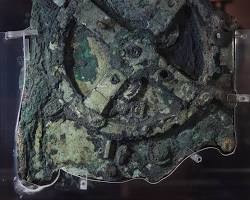
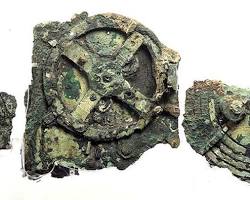
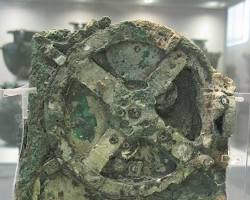
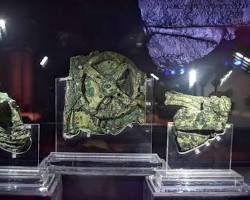
The device was recovered in 1900–1901 by sponge divers from a 1st-century BCE shipwreck off the island of Antikythera, Greece. Coins and artifacts from the wreck date the sinking to around 70–60 BCE, while paleography and technical features suggest the mechanism itself was made earlier, circa 150–100 BCE. It survives in 82 known fragments, the largest of which preserve the principal gear trains and dials.
Design and Operation
Housed in a wooden case roughly 34 × 18 × 9 cm, the mechanism comprises at least 30 intermeshing bronze gears (originally likely more). It employed advanced techniques including epicyclic gearing with a pin-and-slot mechanism to model the Moon’s variable speed.
- Front display: Concentric scales for the zodiac and a 365-day Egyptian calendar, with pointers for the Sun and Moon. A black–white rotating sphere indicated lunar phases. A parapegma (star calendar) correlated dates with stellar risings and settings.
- Back dials: Two spiral dials tracked long astronomical cycles:
- Metonic dial (235 lunar months, 19 years), with a subsidiary Callippic cycle (76 years) and a four-year Games dial referencing Panhellenic festivals (including the Olympics).
- Saros dial (223 lunar months, ~18 years), with an Exeligmos subdial (~54 years) to refine eclipse predictions.
- Eclipse prediction: The mechanism encoded lunar and solar eclipse cycles, indicating likely dates, times, and qualitative details derived from Babylonian-style period relations.
While the Sun–Moon system is securely reconstructed, possible displays or gearing for planetary motions remain debated; some modern models propose full planetary trains, but direct evidence is incomplete.
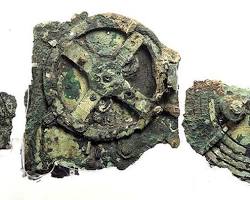
Inscriptions
Extensive Greek inscriptions—about 3,400 legible characters—cover the case and plates, serving as a user’s manual and labeling the scales and cycles. They reference astronomical terms, calendar adjustments, and festival listings, and help identify the functions of the dials.
Provenance and Manufacture
Lettering style and scientific content point to a Hellenistic workshop, with Rhodes often suggested due to known traditions of astronomy and instrument-making (e.g., connections to Hipparchus and Posidonius). The mechanism’s design reflects a synthesis of Greek geometrical astronomy and Babylonian period astronomy.
Significance
The Antikythera Mechanism is the earliest surviving example of a complex geared instrument and a landmark in the history of science and technology. It reveals that ancient Greek artisans could build compact, precise, theory-driven calculators centuries before comparable devices reappear in the medieval and early modern worlds.
Research and Current Location
Housed at the National Archaeological Museum in Athens, the fragments have been studied for over a century. Pioneering work by Derek de Solla Price (1950s–1970s) and high-resolution X-ray computed tomography in the 2000s vastly improved understanding of its gear trains and texts. Ongoing projects continue to refine reconstructions and explore its astronomical models.